Forty, Fearless, and Finally Saying Yes: How the Mature Bride Is Changing Couture
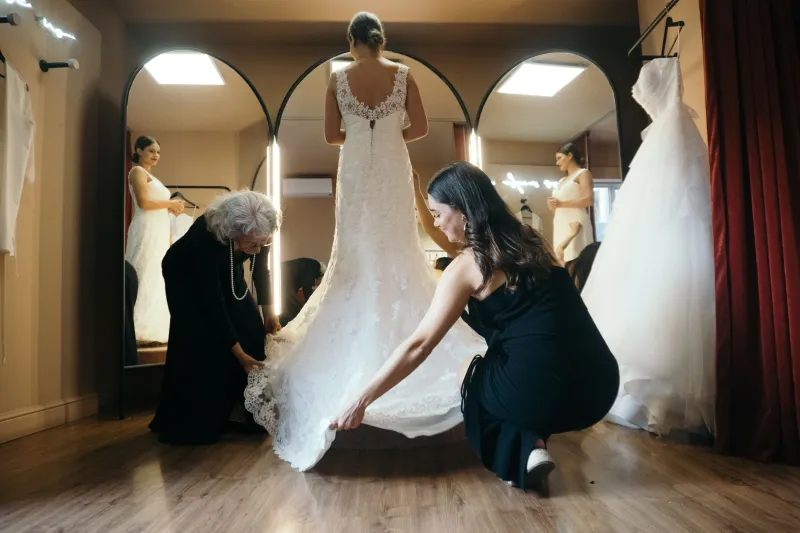
Photo: elegant mature bride trying on couture wedding gown in boutique fitting room, via images.pexels.com
The bride who walks into a couture salon at 43 does not arrive the same way her 26-year-old counterpart does. She has, in many cases, spent two decades building a career, a wardrobe, and a finely tuned sense of what flatters her body and her life. When she finally sits down for a consultation, she is not browsing — she is commissioning.
At Mia Bridal Couture, we have watched this shift unfold steadily over the past five years. Brides over 40 — first-time brides, second-time brides, brides remarrying after long chapters of singlehood or widowhood — now account for a meaningful share of our bespoke appointments. And they are quietly rewriting what bridal couture means.
The Myth of the Rulebook
The old conventions were blunt: past a certain age, a bride should supposedly avoid white, skip the train, cover the shoulders, and keep the celebration modest. Our stylists hear these inherited rules quoted by brides' mothers far more often than by the brides themselves.
"The women I fit in their forties and fifties are the least bound by tradition of anyone who walks through our doors," says longtime salon stylist Mariana Ortiz. "They're not dressing for an Instagram audience or a childhood fantasy. They're dressing for the marriage — and for the photograph they want to look at in thirty years."
In practice, that means the consultation begins differently. Rather than asking what a bride has pinned on Pinterest, Ortiz starts with her life: where the wedding will happen, what she wears when she feels most herself, which decade of her closet she would rescue in a fire. The gown is built outward from that answer.
Silhouettes That Signal Confidence
If there is a signature silhouette among mature brides, it is not the ball gown. It is the column — clean, architectural, unapologetically grown-up — followed closely by a softened mermaid cut with a fluid skirt rather than a rigid one.
"A column gown demands confidence," Ortiz notes. "There's nowhere to hide, and our over-40 brides don't want to hide. They want the line of the dress to do the talking."
That said, generalizations only go so far. We have fitted 52-year-old brides in dramatic cathedral trains and 41-year-olds in tailored jumpsuits with detachable overskirts. What unites them is intentionality. Every design decision — the depth of a neckline, the presence or absence of sleeves, the weight of a hem — is made deliberately, not by default.
Sleeves deserve particular mention. What younger brides often request as a removable option, mature brides frequently demand as the main event: fitted illusion sleeves, sculpted cap sleeves, or long lace sleeves that read as editorial rather than demure. The effect is less coverage than architecture.
Fabric: The Quiet Luxury Play
If silhouettes reveal confidence, fabric choices reveal taste. Brides over 40 gravitate toward materials with depth and drape — silk crepe, duchess satin, heavyweight mikado, and matte charmeuse — over the high-shine organzas and heavily beaded tulle that dominate the younger market.
"They touch fabric the way a collector would," Ortiz says. "They understand why a four-ply silk crepe costs what it costs. I rarely have to explain the difference between a $4,000 gown and a $14,000 gown. They can feel it."
Embellishment, when it appears, tends to be restrained and textural: hand-rolled hems, covered buttons down an exposed spine, a scattering of sequins sewn by hand rather than panels of crystal appliqué. The vocabulary is quiet luxury — a term borrowed from fashion at large, but one that fits bridal's mature segment perfectly.
Adapting the Bespoke Process
Designing for this demographic has changed how our atelier runs consultations. Three adjustments stand out:
- Fewer, longer appointments. Mature brides prefer two in-depth sessions over four rapid ones. They arrive with swatches, not screenshots.
- Honest body conversations. Women who have worn clothes for forty years want a fit that accounts for a real, changing body — not a sample-size fantasy. Our pattern drafters begin with the bride's actual measurements and posture, not a standard block.
- Wardrobe thinking. Many ask whether elements of the gown — a detachable train, a cape, an overskirt — can be reworked into something wearable afterward. The answer, increasingly, is yes, and designers are building for it from the first sketch.
A Demographic Worth Designing For
The numbers explain why the industry is paying attention. Americans are marrying later than ever, and second weddings now represent a substantial share of ceremonies nationwide. Yet most bridal marketing still images a bride in her twenties. The gap between the market and the imagery is exactly where boutiques like ours live.
For brides over 40, the message from the atelier is simple: there is no rulebook, and there never really was. There is only the gown that looks like you — which, at this stage of life, is the only gown worth making.