Confessions From the Cutting Table: An Atelier's Unvarnished Guide to Hiring Your Bridal Seamstress
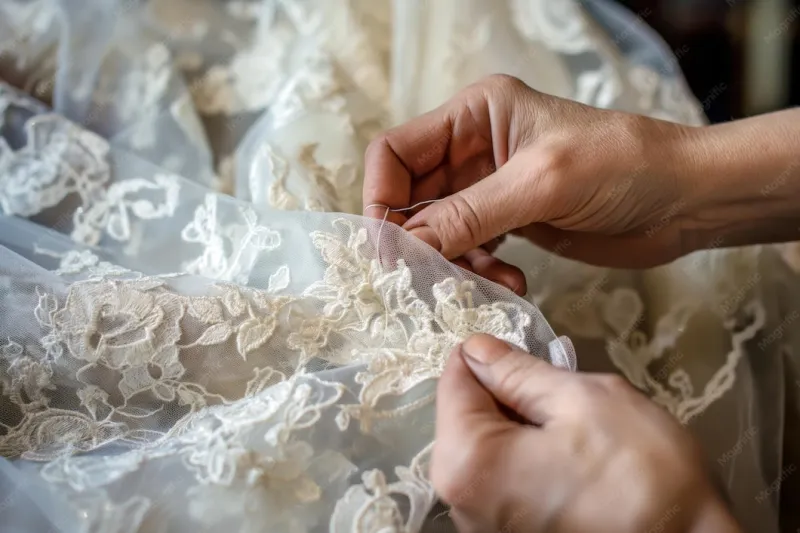
Photo: seamstress hands pinning wedding dress in bridal atelier workshop, via img.freepik.com
There is a conversation that happens in every atelier after the last bride of the day walks out the door. It is not gossip, exactly. It is closer to a debrief — the things we noticed, the timelines that worried us, the requests that made us exchange glances over the cutting table. Brides rarely hear any of it, and honestly, most of it never needs saying. But some of it does.
So consider this the vendor meeting nobody schedules: what a bridal seamstress would tell you, plainly, if the fitting room weren't listening.
The Timeline Is Not a Suggestion — It's Physics
The single most common phone call we receive begins with an apology. I know it's late, but my wedding is in eight weeks. Here is what that call doesn't account for: quality bridal fabric houses in New York and Los Angeles can take six to ten weeks to deliver silk mikado or French lace, and that is before a single stitch is placed. A couture gown is not sewn; it is engineered, in stages, with the garment partially assembled and taken apart as many as a dozen times.
If you want a gown made or substantially reworked, nine months is comfortable. Six is workable. Anything less, and you're not asking a couturière to make a dress — you're asking her to gamble with your wedding day. Most of us won't.
Say the Budget Number Out Loud
American brides are conditioned to treat money talk as gauche, and nowhere more so than in bridal. But here is the uncomfortable arithmetic: when a client withholds her budget, the seamstress is forced to design blind. We either quote high and lose you, or quote low and spend the next four months apologizing for what silk charmeuse actually costs.
Tell us the real number — the one that includes alterations, veiling, and the bustle you haven't thought about yet. A skilled atelier can do remarkable things at nearly any price point. What it cannot do is read minds.
The Requests That Make Us Wince
Not every request is reasonable, and pretending otherwise serves no one. A short list, offered with affection:
- 'Can you copy this Pinterest photo exactly?' We can be inspired by it. We cannot — and legally should not — replicate another designer's copyrighted work stitch for stitch.
- 'My dress needs to fit a body I'll have in five months.' We fit the body that walks in. Purchase your sizing assumptions elsewhere.
- 'Can you just take it in a little the week before?' A gown that fits correctly on the wedding day is finalized at the final fitting, roughly two to three weeks out. Later than that, we are performing surgery on a patient who won't hold still.
- 'I brought nine opinions to my fitting.' We welcome your mother, your maid of honor, your best friend. Nine is a committee, and committees rarely agree on a hemline.
What We Wish You'd Bring Instead
The brides we remember fondly — and there are many — tend to arrive with the same things. Their shoes, actual ones, purchased early. Their undergarments, because a strapless bodice fitted over a regular bra is fiction. Fabric swatches from the venue's linen or the bridesmaids' dresses. And perhaps most valuable of all: one trusted person whose taste they genuinely share.
Bring inspiration, certainly, but bring it as a vocabulary rather than a blueprint. The phrase we love most is not 'make it look like this' but 'this is the feeling I want.' The first limits us. The second is where couture begins.
The Cancellation Call Nobody Makes
Here is the part of the etiquette conversation that stings: when a bride decides a gown isn't working — or the wedding itself changes shape — the atelier is so often the last to know. Fabric has been ordered. Hands have been paid. A quiet email two weeks late can cost a small studio thousands of dollars, and more than one independent seamstress has closed her doors over exactly this.
If something changes, tell us immediately. We promise the conversation is less painful than you fear, and far more graceful than silence.
A Craft Worth Respecting
Bridal sewing is one of the few remaining trades in America where the work is still measured in hours rather than units. The woman pinning your hem has likely spent decades learning how drape behaves, how lace lies, how a bodice must be boned so a bride can dance until midnight without a single adjustment. Treat her timeline, her budget candor, and her expertise with the same care you'd give the gown itself.
The dress will photograph beautifully either way. The experience of making it — that part is shaped by both of you.