Whose Dress Is It Now? Rebuilding an Heirloom Gown Without Erasing Its History
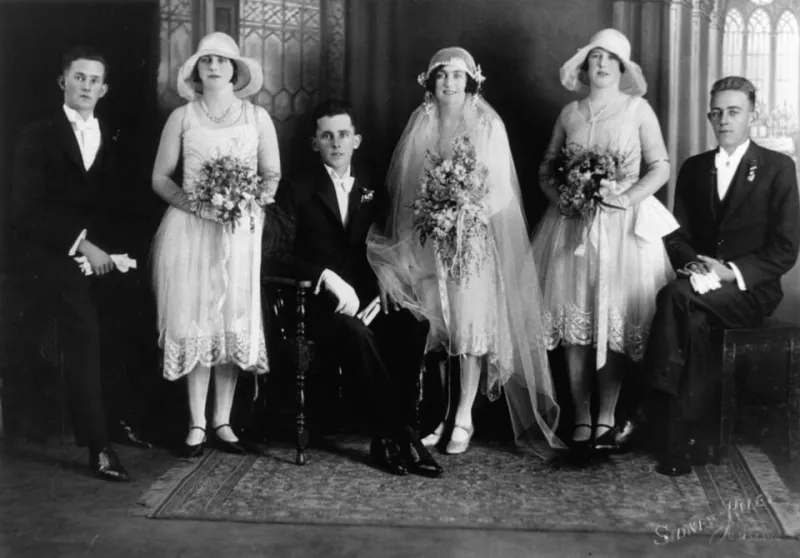
Photo: State Library of Queensland, Australia, No restrictions, via Wikimedia Commons
It begins on a table, not a sketchpad
When a bride arrives at Mia Bridal Couture carrying a garment bag older than she is, we do not start with sketches. We start by clearing the longest worktable in the atelier, laying the gown flat under daylight-balanced lamps, and looking at it for a long, quiet while.
The dress has usually traveled in the dark for decades. It may have been folded in a cedar chest, hung in a dry-cleaning bag that trapped moisture against the shoulders, or wrapped in tissue that has since yellowed along with the silk. What a bride sees is her grandmother on a staircase in 1964. What we see is a textile with a specific age, a specific fiber, and a specific set of failures already in progress.
Both views are correct. Reconciling them is the work.
Reading fabric the way a conservator reads a painting
The first technical pass is unglamorous and decisive. Protein fibers behave differently from cellulosic ones, and time treats them differently still. Silk loses tensile strength as it oxidizes; a bodice that looks intact can part along a fold with the pressure of two fingers. Tulle from the 1950s and 1960s is frequently brittle at the waist seam, where the weight of the skirt has hung for sixty years. Beading from the 1980s is often held by single threads that have been severed by dry-cleaning solvent and are now invisible to the naked eye until they let go.
Yellowing is the point most brides misunderstand. It is rarely dirt, and it does not come out in the wash. It is oxidation of the fiber and, often, residue from sizing and from the original cleaning. A conservator with a museum background can stabilize and, in some cases, reduce it. A standard dry cleaner cannot, and an aggressive attempt can finish the garment permanently.
We also look for what we call honest damage: perspiration staining under the arms, crushed velvet at the hem, the faint ring where a corsage sat. Some brides want these erased. Others want them kept. Neither request is sentimental or cold. Each is a decision about what the dress is for.
The three verdicts
After the assessment, we offer one of three recommendations.
Preserve. The original garment is stabilized, re-lined, and worn essentially as it was, with new internal structure carrying the weight. This is the choice for gowns with exceptional lace, garments that have already been professionally conserved, and families for whom the dress is a document rather than a wardrobe item.
Restore. Missing beading is rewoven, a shattered panel is backed with matching silk, and the repair is designed to be invisible from a respectful distance. Restoration is the most conservative option that still allows the gown to be worn.
Rebuild. A portion of the original is reincarnated: the lace of a 1948 bodice appliquéd onto a newly drafted silk faille gown, the grandmother's hand-embroidered hem transferred to a modern column, the seed pearls reset onto a cape. The old garment does not survive as a garment. It survives as material and as intent.
There is a fourth path that families rarely anticipate and often love: the dress is preserved in full for the archive, and a fragment — a piece of hem lace, a covered button, a length of ribbon — is built into the new gown at the waist or beneath the skirt, where only the bride knows it is there.
What it actually costs
Heirloom work is priced per hour and per risk, and it is not less expensive than a new gown. A stabilized re-fit with new lining and structural support typically lands between $1,200 and $2,500. A full reconstruction using new silk plus hand-applied antique lace generally runs $3,500 to $7,000, and can exceed that when the lace must be individually conserved before application. Independent textile conservation, when we recommend it, is a separate engagement, usually $300 to $600 for an assessment and written treatment plan.
Two additional line items deserve early mention. First, matching silk is the single greatest scheduling risk; dye lots for a 2026 bolt will not match a 1962 one, which is why we often pair antique material with a deliberately contrasting modern silk rather than chasing an impossible match. Second, the finished gown should be insured as a scheduled item on the bride's or family's policy, and stored archivally after the wedding rather than returned to the same cedar chest.
The ethics of cutting
The decision to cut into an heirloom is irreversible, and we say so plainly before anyone picks up shears. Cutting a 1948 Alençon lace bodice to fit a modern frame destroys information — the original seam lines, the maker's construction choices, the evidence of how the dress was worn. A conservator would object. A bride who wants to wear her grandmother's dress rather than display it has a legitimate counterargument.
Our practice is to ask three questions in order. What would the original wearer have wanted? If she is living, she answers for herself. If she is not, we ask the person who knew her best, and we listen for what they do not say. Second, can the goal be met without cutting the lace? Third, if we cut, will the bride be at peace with that in twenty years, when she is the one being asked for permission?
Whatever is decided is written into the commission record, with photographs of the gown before work begins. Families remember decisions differently over time. Documentation is a kindness to everyone, including the bride herself.
The family table
Heirloom commissions involve more people than any other gown we make, and the negotiation is real. A grandmother may have promised the dress to two granddaughters. A mother may have strong feelings about the sleeves she wore in 1989. An aunt may believe the dress should remain untouched in a box forever.
We recommend a family viewing before the first toile, held in the atelier rather than at home, so that everyone sees the same garment under the same light. We ask each person for one priority and one concession. The bride then holds the veto, stated openly and kindly at the outset, because a committee cannot design a wedding gown.
The most common resolution is a division of the dress's meaning rather than its fabric: the ceremony in the heirloom or a rebuilt version of it, the reception in something wholly new, and a small inherited detail on each.
The body that inherits
A gown cut in 1955 for a size 8 is not a size 8 in 2026. Pattern grading, average height, and foundation garments have all changed, and the original bodice was built around a corsetry system most modern brides will not wear. The rebuild usually requires a newly drafted interior structure, which is the least visible and most expensive part of the work.
This is also the point where brides often decide, quietly, that they want their own gown. That decision is not a betrayal. A grandmother's dress can be honored in a ring pillow, a wrap for the reception, a framed fragment, or a second-act gown for a future daughter. The atelier has seen every version of this choice, and none of them is the wrong one.
The last inch of the hem
The final fitting is when it becomes clear whether the decision was right. The bride stands in a gown that contains both an old hand and a new one, and the room goes quiet in a different way than it did at the first appointment.
Whatever the verdict — preserved, restored, rebuilt, or released — the heirloom has done its job. It carried a family forward across sixty years and arrived, intact enough, at a table in 2026 where someone finally asked what it wanted to be next.