Marry the Room: Why Your Venue Should Sit in on Every Fitting
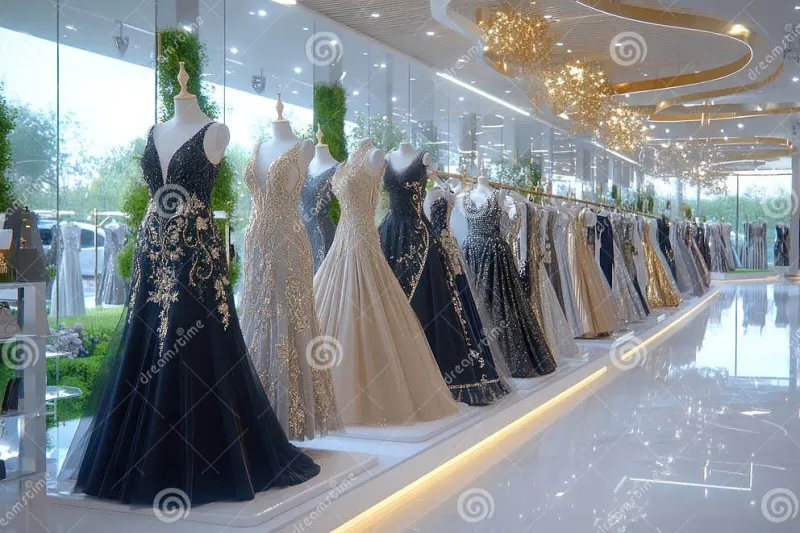
Fitting rooms are designed to flatter. The lighting is warm and directional, the carpet is dense enough to quiet a heel, the mirror sits at a height that lengthens the leg, and the temperature is regulated to a degree most venues cannot manage in any season. A gown chosen exclusively in that environment is a gown chosen under laboratory conditions.
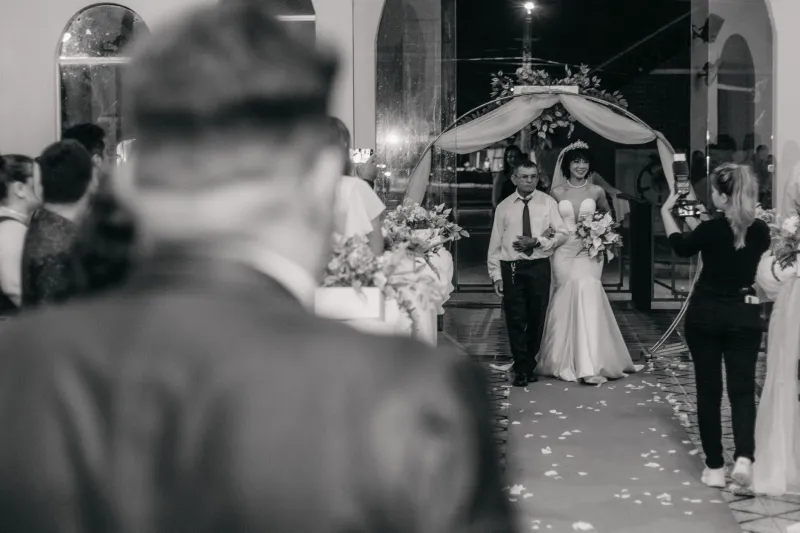
The wedding, by contrast, happens in a real room. It happens under the light that room offers at four in the afternoon, across the floor that room actually has, down an aisle of whatever length the space allows. The most useful thing a bride can bring to a couture consultation is not a photograph of a gown. It is a description of the room.
The Fitting Room Is a Liar
Three variables decide how a gown performs, and none of them appear in a fitting room.
Light. Natural light from a bank of windows renders ivory, blush, and champagne very differently than the tungsten glow above a pedestal. Beaded and sequined surfaces read as texture in daylight and as sparkle under low light. A gown that looks luminous at noon can look grey at seven in the evening.
Floor. Hardwood, marble, grass, gravel, sand, and polished concrete each change how a train behaves and how a bride walks. A cathedral train on a marble staircase is a photograph. The same train on damp grass is a cleaning bill.
Scale. A short aisle rewards detail at close range. A long aisle or a grand staircase rewards silhouette. A gown designed for a fifty-foot walk through a ballroom may look under-resolved in a twelve-pew chapel, and the reverse is equally true.
A Venue-by-Venue Primer
Barn, Loft, or Rustic Estate
Texture is the governing principle. Linen, raw silk, and matte crepe hold their own against wood and hay without competing. Avoid high-sheen satin, which reads as costume in a barn. Choose a sweep or chapel train; a full cathedral train will collect the floor. Footwear matters more here than anywhere else — a block heel or a dressy flat will save the day on uneven boards.
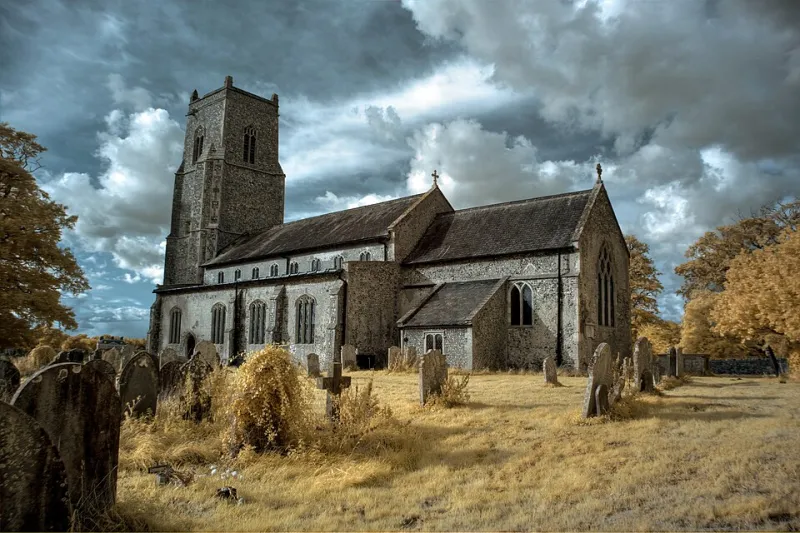
Cathedral or Historic Church
Light is vertical, cool, and dramatic. Structured fabrics — mikado, duchesse satin, faille — carry in a nave where soft draping disappears. This is the venue that earns a long train, and the one place where a veil of real length pays for itself. Ask whether the aisle is carpeted; stone and carpet demand different shoe choices and different train weights.
Ballroom or Hotel
Chandeliers, polished floors, and a long approach. Satin and beaded surfaces come alive under warm low light. A ballroom can carry embellishment that would overwhelm a garden. Consider how the gown reads under evening light specifically, and ask your atelier whether you can view fabric samples under warm bulbs as well as daylight.
Garden, Tent, or Lawn
Consider the ground first and the aesthetics second. A hemline that sits one half-inch above the grass is a hemline that stays clean. Light, airy fabrics are correct here; heavy structured gowns look out of place against greenery. Wind is a design consideration — an unweighted skirt in an open field behaves unpredictably in photographs and in motion.
Waterfront, Beach, or Coastal
Salt air and humidity alter how natural fibers hang. Bias-cut silk can grow in humidity between the fitting and the ceremony. Choose fabrics with some body, plan a final fitting close to the date, and keep the train short and detachable. Sand demands either a flat or a deliberate barefoot choice; there is no elegant middle ground.
Mountain Lodge or Winter Venue
Layers and weight. A gown with a substantial skirt and a matching capelet or jacket photographs beautifully against snow and stone. Consider a hem that clears the floor — a wet, salted floor will mark a light-colored silk within minutes. Lining matters more in cold weather than most brides expect.
Courthouse or City Hall
Scale, not spectacle. A short aisle and a small room reward detail at close range: a striking neckline, a hand-finished sleeve, a beautiful back. This is the venue where a silk suit, a column gown, or a short dress outperforms a ballgown, and where a long train reads as an obstacle rather than a gesture.
The Physics of Walking
A gown must survive motion. Ask your atelier to let you walk — not turn on a pedestal, but walk a genuine distance at a genuine pace in your actual shoes. Ask how the gown behaves when you climb three steps, when you turn in a doorway, when someone steps on the hem. Every one of these is a venue condition disguised as a fitting question.
The Checklist to Bring to Your Consultation
- Photographs of the space, taken at the time of day your ceremony begins
- The length of the aisle in paces, and whether it is carpeted, stone, wood, or grass
- Whether the ceremony is indoors, outdoors, or both, and the plan if weather turns
- The exact shoes, or a shoe of identical heel height and width
- The number of steps or stairs between the dressing room and the aisle
- Whether the reception floor is the same surface as the ceremony floor
- The season, and whether the space is heated, cooled, or neither
The Final Walk-Through
If your venue allows it, request access for a single walk-through in the finished gown before the wedding day, even if only for twenty minutes. Brides who do this almost always return with one adjustment — a hem shortened, a train made detachable, a bustle moved — and that adjustment is usually the difference between a gown that looks correct and a gown that works.